
How Logicare is Shaping the Future of Digitalization and Human-Centered Supply Chains in Industry 5.0
The logistics industry is evolving faster than ever. Artificial Intelligence (AI), Warehouse Management Systems (WMS), automation, Business Intelligence (BI), and data-driven decision-making are redefining how businesses manage operations. Yet, as the world moves into Industry 5.0, one truth becomes increasingly clear:
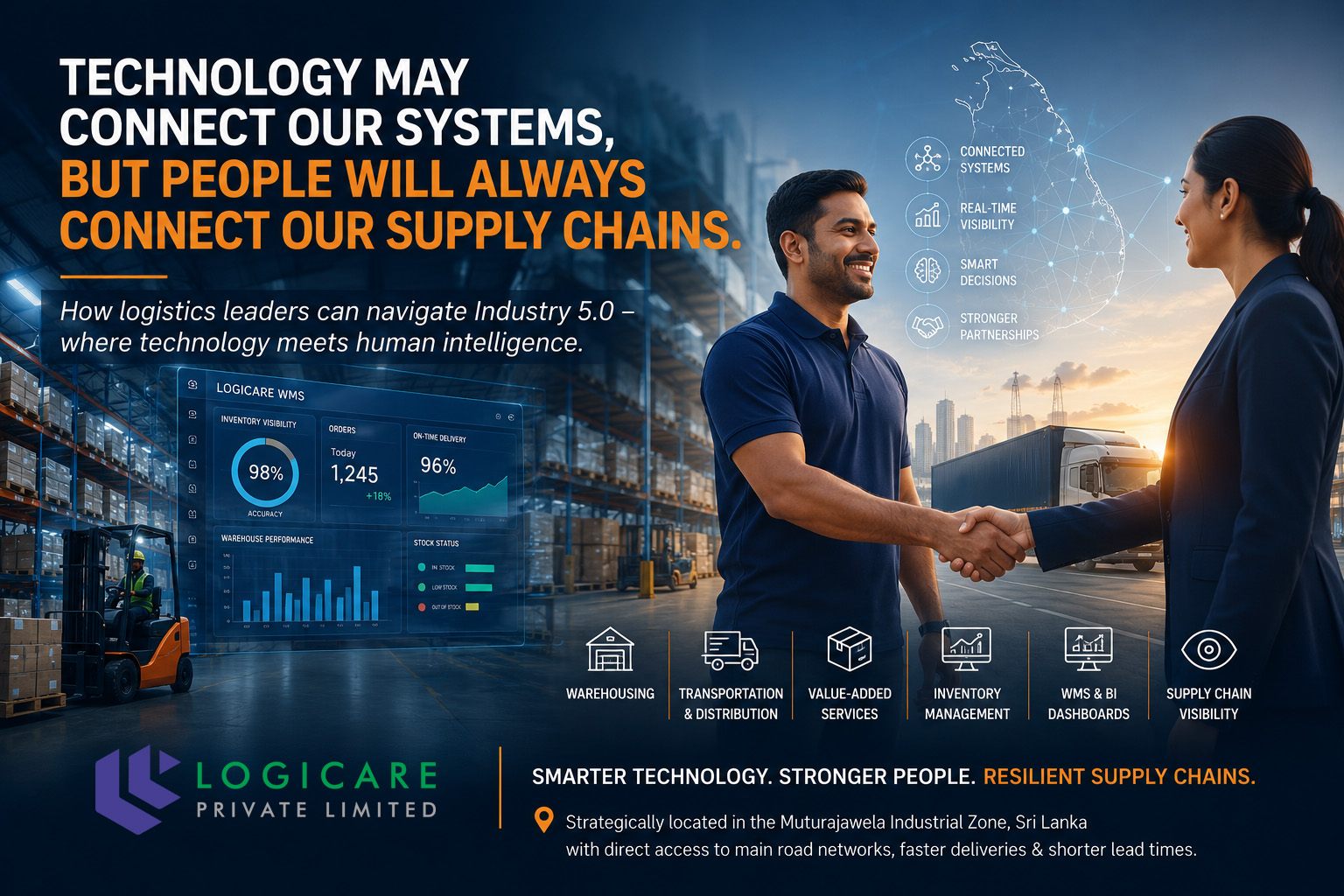
Technology can connect systems, but people will always connect supply chains.
At Logicare, we believe digital transformation is not about replacing people with technology. It is about empowering people with the right technology to build smarter, more resilient, and customer-focused supply chains. As a leading third-party logistics (3PL) provider in Sri Lanka, Logicare combines advanced logistics solutions with experienced professionals to deliver efficient, sustainable, and scalable supply chain solutions tailored to every client.
This philosophy perfectly reflects Industry 5.0—where human intelligence and digital innovation work together to create better business outcomes.
Industry 5.0: The Next Evolution of Supply Chains
Industry 4.0 introduced automation, connectivity, and intelligent systems. Industry 5.0 builds on that foundation by placing people back at the center of technology.
Rather than asking:
"How much can technology automate?"
Industry 5.0 asks:
"How can technology help people make better decisions?"
For logistics companies, this means using digitalization to improve visibility, efficiency, collaboration, and customer service—while ensuring human expertise continues to guide every critical decision.
Leadership in the Digital Age
Successful digital transformation begins with leadership—not software.
Modern logistics leaders carry three essential responsibilities.
- Create a Clear Vision
People embrace change when they understand its purpose.
Whether introducing a Warehouse Management System, Business Intelligence dashboards, or automated reporting, employees need to know how these improvements benefit customers, the organization, and their own careers.
- Invest in People
Technology changes rapidly.
Skills must evolve just as quickly.
Organizations that continuously invest in:
- Training
- Upskilling
- Coaching
- Leadership development
will always outperform organizations that invest only in technology.
At Logicare, continuous improvement is not simply about adopting new systems—it's about ensuring people have the knowledge and confidence to use them effectively.
- Build Trust
Digitalization should never create fear.
Employees should view technology as a tool that removes repetitive work, reduces errors, and creates opportunities—not as something that replaces them.
Trust remains one of the most valuable assets in every successful supply chain.
Digitalization is a Journey—Not a One-Time Investment
One of the biggest misconceptions in logistics is that digital transformation begins with purchasing expensive software.
It doesn't.
Especially in developing economies like Sri Lanka, businesses often face infrastructure limitations and budget constraints. Investments such as:
- Warehouse Management Systems (WMS)
- Enterprise Resource Planning (ERP)
- Warehouse robotics
- Automated Storage & Retrieval Systems (AS/RS)
- AI-powered automation
require careful planning and measurable returns.
Digitalization should always begin with a simple question:
"What business problem are we trying to solve?"
Sometimes the answer isn't technology.
It could be:
- Better warehouse layouts
- Improved picking routes
- Standardized operating procedures
- Stronger inventory control
- Better communication between departments
Only after identifying recurring bottlenecks should businesses introduce digital solutions.
Technology should support operational excellence—not replace common sense.
Smart Technology Requires Smart Infrastructure
Exciting innovations such as drone-based inventory counting and AI-powered warehouse automation often attract attention.
But successful implementation depends on operational readiness.
Before investing in advanced technology, logistics businesses should ask:
- Are warehouse layouts optimized?
- Is inventory accurately barcoded?
- Are storage locations standardized?
- Are processes already efficient?
Technology amplifies good processes.
It cannot fix poor ones.
This practical mindset is central to successful digitalization.
Developing the Next Generation of Supply Chain Leaders
Today's logistics workforce is increasingly made up of Millennials and Generation Z professionals.
These employees are digitally confident, adaptable, and comfortable with modern technology.
However, future supply chain leaders require more than technical knowledge.
They need:
- Critical thinking
- Communication
- Emotional intelligence
- Problem-solving
- Customer relationship management
Technology should remain a decision-support tool—not the decision-maker.
Business Intelligence dashboards can display:
- Inventory accuracy
- Order fulfillment rates
- Delivery performance
- Productivity trends
- AI-generated forecasts
But dashboards cannot build relationships.
Only people can.
As often said in modern logistics:
Dashboards provide data. People provide context.
Digital Supply Chains Require Human Collaboration
A supply chain is much more than warehouses and transportation.
It is a connected ecosystem involving:
- Manufacturers
- Importers
- Exporters
- Logistics providers
- Ports
- Customs
- Freight forwarders
- Government agencies
- Retailers
- Customers
No organization can optimize the entire supply chain independently.
Collaboration remains the greatest competitive advantage.
Sri Lanka has already made encouraging progress through increased digital government services and electronic submissions.
The next step is achieving greater interoperability—where different systems communicate seamlessly without requiring every organization to use identical software.
Imagine:
- Manufacturers sharing inventory updates instantly
- Logistics providers receiving automatic shipment requests
- Customers tracking inventory in real time
- Customs approvals integrating directly into logistics systems
This level of digitalization reduces paperwork, eliminates delays, and significantly improves supply chain visibility.
Why Digitalization Matters for Sri Lanka
Sri Lanka occupies one of the world's most strategic shipping locations along the busy East-West maritime trade route.
To fully capitalize on this advantage, stronger collaboration between:
- Government
- Industry
- Universities
- Technology providers
- Logistics companies
is essential.
Countries like Singapore have demonstrated that global logistics leadership depends not only on technology but also on shared standards, transparency, and collaboration.
Technology enables connectivity.
People create partnerships.
Industry 5.0 and the Future of Work
Perhaps the most common question today is:
Will Artificial Intelligence replace logistics jobs?
The more realistic answer is:
AI will transform jobs—not eliminate human value.
Automation will increasingly handle repetitive administrative work, allowing professionals to focus on:
- Customer engagement
- Strategic planning
- Innovation
- Continuous improvement
- Relationship management
Industry 5.0 does not replace Industry 4.0.
It enhances it by introducing the human element.
Tomorrow's most valuable professionals won't necessarily be those who know every AI tool.
They will be those who combine technology with:
- Experience
- Judgment
- Creativity
- Empathy
- Leadership
These qualities cannot be automated.
The Logicare Approach to Smarter Supply Chains
At Logicare, digitalization is viewed as a strategic journey rather than a destination.
Located within the Muturajawela Industrial Zone, Logicare delivers integrated logistics solutions including warehousing, transportation, inventory management, value-added services, Warehouse Management Systems (WMS), and Business Intelligence dashboards to help businesses improve operational performance.
Every digital initiative is driven by one objective:
Creating smarter, more efficient, and more customer-focused supply chains while keeping people at the center of every decision.
By combining technology with operational expertise, Logicare helps businesses gain greater visibility, improve productivity, reduce operational complexity, and build resilient supply chains prepared for the future.
Conclusion
Technology will continue to evolve.
Artificial Intelligence will become smarter.
Automation will become faster.
Data will become richer.
Yet the strongest supply chains will always be built on something technology alone cannot create:
Trust.
Trust is built through leadership.
Trust is strengthened through communication.
Trust grows through long-term partnerships.
At Logicare, we believe that digitalization is most successful when it empowers people—not replaces them.
Because while technology may connect our systems…
People will always connect our supply chains.
Ready to Build Smarter Supply Chains with Logicare?
Whether you're looking to optimize warehouse operations, streamline transportation, improve inventory visibility, or accelerate your digital transformation journey, Logicare has the expertise and technology to help your business move forward. Backed by integrated logistics solutions, advanced digital capabilities, and a customer-centric approach, we help businesses build smarter, more agile, and future-ready supply chains.
Let's build a smarter supply chain together.
Contact Logicare today to discover how our tailored logistics solutions can improve efficiency, reduce costs, and drive sustainable business growth. Your journey toward a more connected, resilient, and digitally empowered supply chain starts here.