
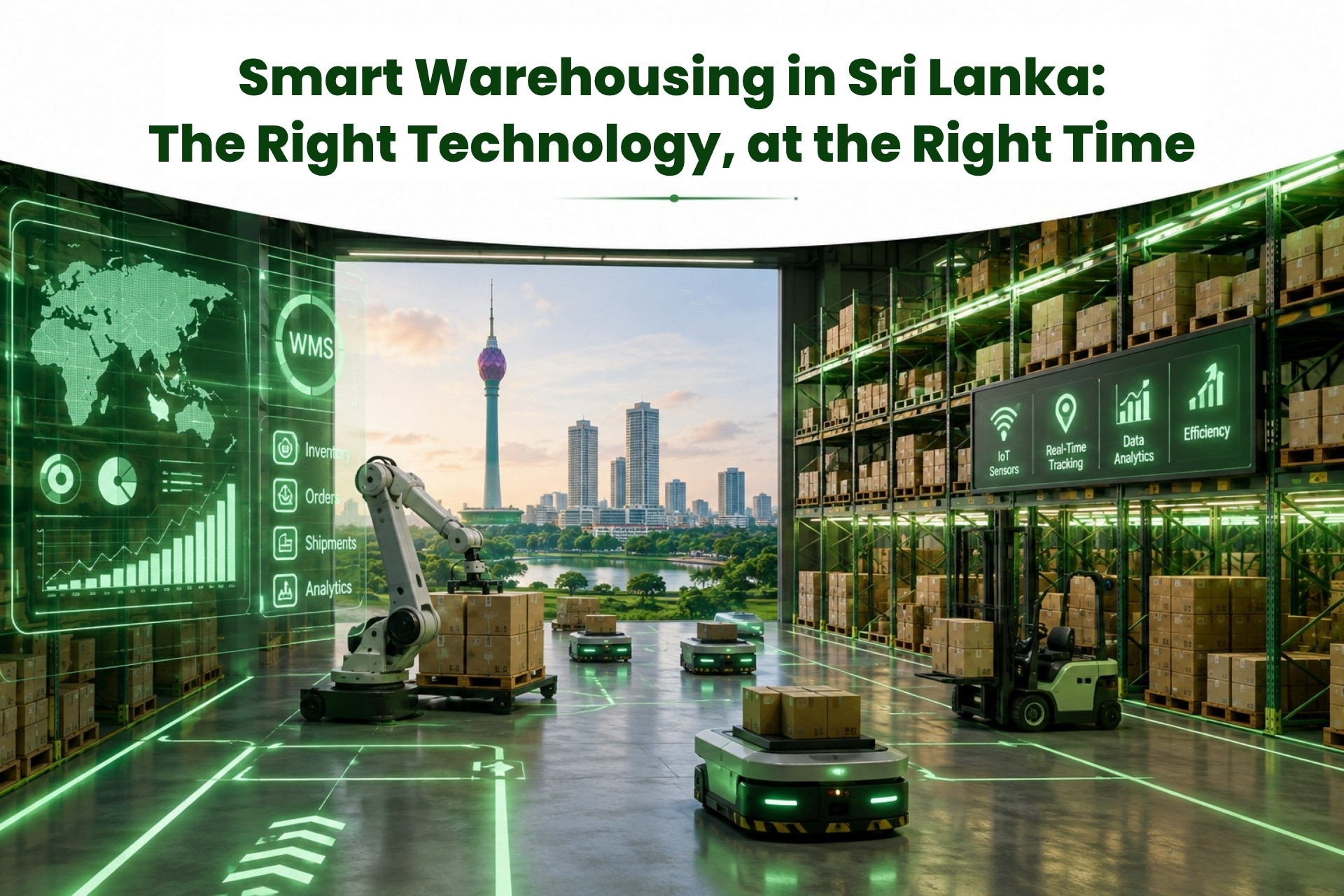
The future of warehousing in Sri Lanka has less to do with buying expensive technology, and more to do with solving the right problem, at the right time, with the right tool.
Walk into a modern distribution centre in Singapore, Rotterdam or Dubai and you'll see autonomous robots gliding between racks, drones running cycle counts overhead, dashboards flagging stockouts before they even happen. It's an impressive sight, and it's also the picture that gets used to sell warehouse automation to businesses everywhere, Sri Lanka included.
For most Sri Lankan businesses, and the small and mid-sized 3PL providers who serve them, that's not really the question worth asking. The question is where to start, and what will actually move the needle for their operation.
What a WMS Actually Does
A Warehouse Management System is software that governs the day-to-day movement and storage of inventory: goods receipt, put-away, picking, packing and dispatch. Done well, it gives real-time visibility into stock levels, automates replenishment triggers, optimises storage locations and cuts down the manual errors that come with spreadsheet or paper-based tracking.
For a business still running on stock cards or an Excel sheet, moving to even a basic WMS can change accuracy rates, order turnaround, and how confident customers feel about delivery promises. Customers now expect real-time order visibility as a matter of course. A WMS isn't a luxury on top of that anymore; it's close to a baseline requirement.
Why Sri Lankan Warehouses Are Going Digital
Sri Lanka's logistics sector is at an interesting point right now. E-commerce adoption has picked up sharply since the pandemic, FMCG and retail brands want tighter inventory accuracy, and pharmaceutical and export manufacturers need traceability that a manual system just can't deliver.
At the same time, digital literacy here is a real advantage, sitting around 65% overall and above 90% among younger workers. So the workforce needed to operate digital warehouse tools is largely already there. The barrier isn't a skills gap in the way people often assume; it's more of an infrastructure and investment-sequencing gap.
This lines up with what the World Economic Forum has found in its research on business transformation: skills gaps, not the technology itself, are what employers most often cite as the biggest barrier to digitalizing. Translated to warehousing, that means the software and hardware are rarely the hard part. The hard part is training teams to trust and use the new tools properly, and rebuilding workflows around them.
The Spectrum of Warehouse Automation
Automation isn't one decision, it's a spectrum, and knowing where your operation actually sits on it matters before you spend a single rupee:
Level 1: Foundational Digitization. Barcode or QR-code scanning, digital stock ledgers, basic WMS modules for receiving, put-away and picking. This is where most Sri Lankan warehouses should start if they haven't already.
Level 2: Process Automation. Automated replenishment alerts, WMS-to-ERP integration, pick-path optimisation, and dashboards that give managers real-time KPIs instead of end-of-day reports.
Level 3: Physical Automation. Conveyor systems, automated sortation, semi-automated picking aids.
Level 4: Advanced Automation. Automated Storage and Retrieval Systems (AS/RS), robotics, drone-based cycle counting.
It's worth being honest about Level 4. Drone-based cycle counting looks great in a demo video, but before anyone adopts it there are harder questions to answer first. Is the racking suitable? Is inventory properly barcoded and location-mapped? Is there enough transaction volume to justify the capital cost? For most operators in Sri Lanka today, the honest answer still points back to Levels 1 and 2, and that's not a limitation. It's just a sensible order to do things in.
The ROI Question: What Makes Sense for Emerging Markets
A full WMS, an ERP platform, AS/RS, robotics: all of it comes with a steep price tag. For small and mid-sized logistics providers, and the businesses they serve, the ROI timeline on advanced automation can be genuinely hard to justify, and pretending otherwise doesn't help anyone.
Digitalization doesn't start with expensive technology, and it doesn't happen overnight. It's a step-by-step process that starts with identifying the actual business problem, not the shiniest tool on the market.
At Logicare, that's why we approach digital transformation problem-first rather than technology-first. Before we recommend any system, we ask what's actually causing the bottleneck. Is it the layout, the process, or a genuine technology gap? Often the fix turns out to be a smarter warehouse layout or a redesigned pick-path, no capital spend required. Digital tools only make sense once a problem is repetitive, creates a measurable bottleneck, or is genuinely hurting productivity.
Building the Case for a Phased Approach
A practical digitalization roadmap for a Sri Lankan warehouse usually looks something like this:
- Audit before you invest. Map current workflows and find out where errors, delays or excess handling are actually happening.
- Fix the fixable for free. Layout redesigns, SKU slotting logic and process standardization often deliver 20-30% efficiency gains before a single rupee goes toward software.
- Digitize the transaction layer. Bring in barcode scanning and a foundational WMS to remove manual data-entry errors and get real-time stock visibility.
- Integrate, don't isolate. Connect the WMS to your ERP and, where it makes sense, to customer-facing portals, so data moves without manual re-entry.
- Automate selectively. Bring in physical automation only where volume and cost structure genuinely justify it.
- Train continuously. Technology moves fast. The people operating it need ongoing upskilling, not a single onboarding session.
What This Means for Businesses Choosing a 3PL Partner
If you're a manufacturer, retailer or distributor sizing up warehousing partners in Sri Lanka, don't judge "smart warehousing" purely by how much technology a provider shows off. Ask instead:
- Does the provider give you real-time stock visibility?
- Can they show measurable accuracy and error-reduction improvements from their systems?
- Do they have a customer portal or reporting mechanism, so you're not calling for updates?
- How do they train and retain the people running these systems?
A warehouse with a well-implemented, appropriately scaled WMS will consistently outperform one running expensive but poorly integrated automation. Technology should fit the business, not the other way round.
The Human Side of Smart Warehousing
It's easy, in any conversation about automation, to focus entirely on hardware and software. But the businesses that get the most out of digital warehousing are the ones that pair technology with strong people processes: clear SOPs, well-trained supervisors, and a culture where staff see new tools as making their jobs easier rather than threatening them.
Dashboards give managers data. People still provide the context: catching the anomaly a system missed, resolving the exception that doesn't fit the standard workflow, keeping the client relationship that brings the business back. Done right, smart warehousing doesn't replace that judgment. It frees people up to use it where it actually matters.
Common Mistakes Businesses Make When Digitalizing Warehousing
Even well-intentioned digitalization efforts stumble. A few mistakes keep coming up:
Buying software before fixing the process. Digitizing a broken workflow just makes the same mistakes happen faster, now with a monthly subscription attached. Process discipline has to come first.
Under-investing in training. A WMS is only as good as the team's confidence in using it. Rushed onboarding leads to workarounds, staff quietly reverting to manual tracking "just in case", which defeats the point of the investment.
Choosing systems that don't integrate. A WMS that can't talk to your ERP or your customer's ordering portal just creates a new manual data-entry bottleneck instead of removing one. Integration should be a non-negotiable evaluation criterion, not an afterthought.
Automating for the sake of automating. Not every repetitive task needs a robot. Some just need a better-designed process. Knowing when to say "this doesn't need automation yet" matters as much as knowing when to invest.
Frequently Asked Questions
Is a WMS worth it for a small or mid-sized warehouse in Sri Lanka?
In most cases, yes. Even a foundational, cloud-based WMS module can meaningfully cut picking errors and improve stock accuracy at a cost point smaller operators can manage, well before physical automation even enters the conversation.
How long does it typically take to implement a basic WMS?
It depends on how complex the facility is, but a foundational WMS covering receiving, put-away and picking can often go live within a few weeks to a couple of months, provided the underlying processes and SKU data are clean before implementation starts.
Do we need barcode scanning before we can use a WMS effectively?
Generally, yes. Barcode or QR-code scanning is the practical starting point for any WMS implementation, since it's what enables real-time, accurate transaction data. Running a WMS on manual data entry alone limits its value considerably.
What's the biggest barrier to warehouse digitalization in Sri Lanka: technology or people?
Research from bodies like the World Economic Forum consistently points to skills gaps, not the technology itself, as the main barrier to successful digitalization. In warehousing, that means training and process redesign matter as much as, or more than, whichever software gets chosen.
Final Thought
Sri Lanka's warehousing sector doesn't need to leapfrog straight to robotics to be competitive. What it needs is disciplined, sequenced digitalization: starting with visibility, moving to integration, and only then automating where the numbers actually justify it. That's a more sustainable path to efficiency than chasing the most impressive demo reel.
Partner with a 3PL That Gets the Balance Right
At Logicare, we combine practical, phased digitalization with hands-on warehousing expertise, so you get real efficiency gains without paying for technology you don't yet need.
📞 Call/WhatsApp: 076 265 3939
📍 No 1. Muthurajawella Road, Muthurajawella.